
Mar 16 2026
How to Manage a Shared Custody Schedule Between Two Homes
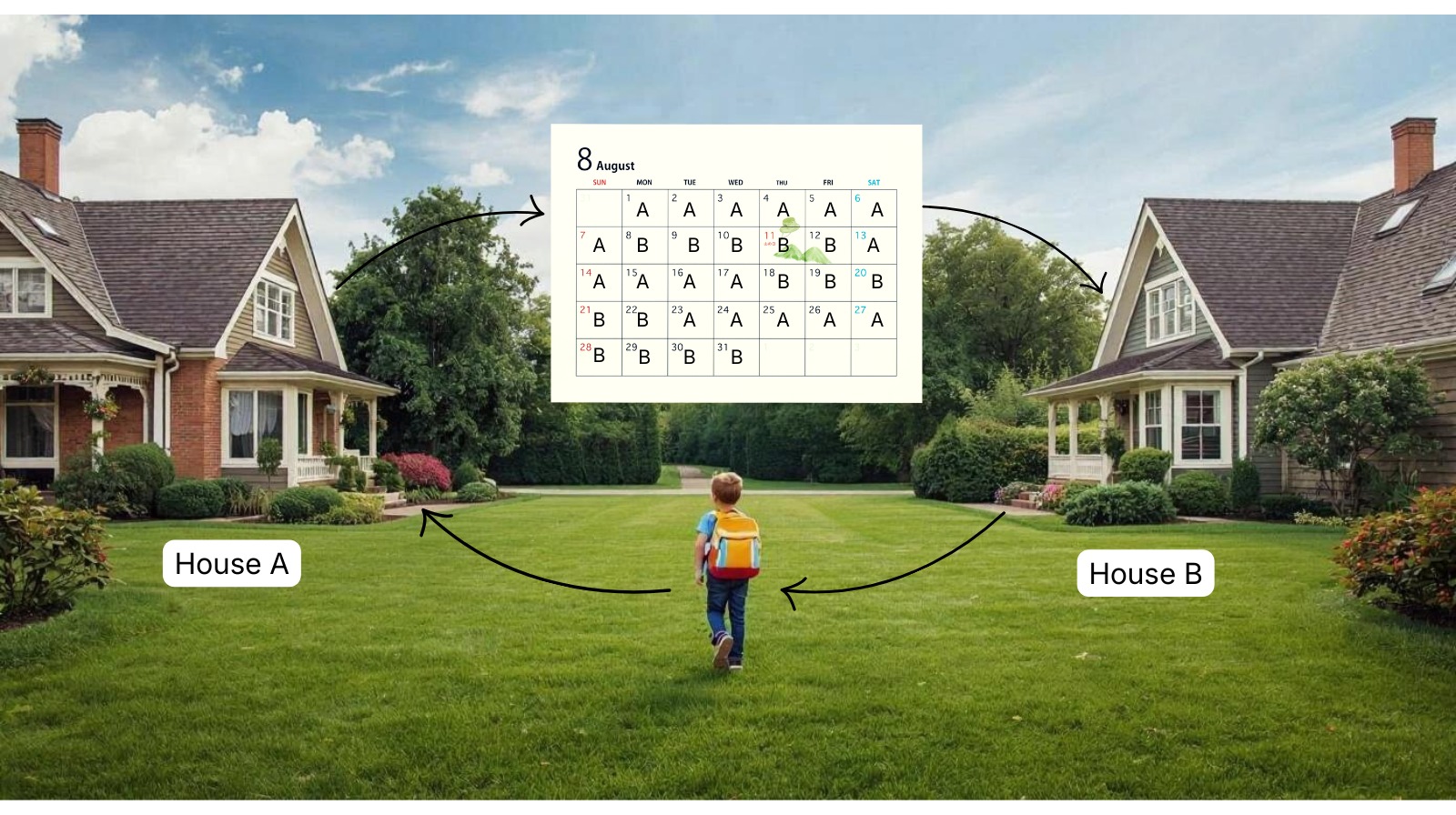
When parents separate, one of the biggest challenges is organizing daily life between two homes.
Children still have school, activities, doctor appointments and family routines. Coordinating all of this between two parents can quickly become complicated if there is no clear structure.
Many separated parents struggle with questions such as:
- Who has the children this weekend?
- How do we manage holidays?
- What happens if one parent needs to change the schedule?
Creating a clear shared custody schedule is one of the best ways to reduce confusion and help children feel secure.
Why a clear custody schedule matters
Children thrive when they have predictable routines.
After a separation, the transition between two homes can be stressful if schedules change constantly or if communication between parents is unclear.
A well-defined parenting schedule helps:
- reduce misunderstandings between parents
- create stability for children
- simplify planning for school and activities.
When both parents know exactly where the children will be and when, daily organization becomes much easier.
Common shared custody schedules
There is no single schedule that works for every family. The best solution depends on the children’s ages, the distance between homes and the parents’ availability.
Here are some common parenting schedule models.
Alternating weeks
One of the simplest schedules is alternating weeks. Children spend one full week with each parent.
This arrangement works best when parents live close to each other and children are older.
2-2-5-5 schedule
In this model, children spend:
- two days with one parent
- two days with the other
- then alternate five-day periods.
This schedule allows children to see both parents frequently while still creating longer blocks of time.
3-4-4-3 schedule
Another option is the 3-4-4-3 rotation, where children alternate between parents every three or four days.
This type of schedule works well for younger children who benefit from shorter separations.
The challenges of managing custody schedules
Even when parents agree on a schedule, real life often creates changes.
Unexpected events can include:
- school activities
- doctor appointments
- vacations
- last-minute work commitments.
Without a clear system to track these changes, confusion can easily arise.
Parents often end up relying on text messages or emails, which can quickly become difficult to follow.
Using digital tools to manage parenting schedules
Many separated parents now use co-parenting apps to help manage custody schedules.
These tools allow parents to:
- share a parenting calendar
- track schedule changes
- coordinate activities
- keep communication about the children in one place.
By centralizing this information, parents can avoid misunderstandings and ensure both households stay aligned.
You can compare several of the most popular tools in our guide to the best co-parenting apps for separated parents:
👉 https://www.2houses.com/en/blog/best-co-parenting-apps
Tips for successful co-parenting schedules
Regardless of the schedule you choose, a few principles can make co-parenting easier.
Keep the schedule consistent
Children adapt better when routines stay predictable. Try to avoid frequent last-minute changes whenever possible.
Plan holidays in advance
School holidays and vacations should ideally be planned well ahead of time to avoid conflicts.
Keep communication focused on the children
Clear and respectful communication helps prevent small issues from becoming larger conflicts.
Final thoughts
Managing a shared custody schedule between two homes can feel overwhelming at first.
However, with a clear parenting plan and the right tools, many families find that organization becomes much easier over time.
Digital tools and co-parenting apps can help parents coordinate schedules, track important information and keep communication focused on what matters most: the well-being of the children.
FAQ recommandée
What is a shared custody schedule?
A shared custody schedule defines when children stay with each parent after a separation. It helps create stability and clear routines between two homes.
What is the most common custody schedule?
Common schedules include alternating weeks, 2-2-5-5 schedules and 3-4-4-3 rotations depending on the children’s age and the parents’ availability.
How do parents manage custody schedules?
Many parents use shared calendars or co-parenting apps to track schedules, activities and schedule changes.
Why 2houses?
We are a co-parenting facilitator!
calendar
A calendar for everyone, getting organised when you’re divorced is a priority. 2houses provides you an online shared schedule, with many editing, adding, and sync features.
Finance
For us, as divorced parents, the financial topic is most of the time a conflict topic. Now, 2houses manages all expenses from each parent, keeps you informed on the situation, day after day, coins after coins.
Messages
Communication is key, this is why 2houses offers you an online messaging tool, simple, efficient and secure.
Journal
The journal is your quick family social network. You can easily share all information, news, photos, videos, and even your children’s funny quotes. The family is never far away, no matter where you are geographically located.
Try 2houses for your family
We offer a 14-day trial to test our services and start improving your family life!
Get started!